Retail Apps Are Systems, Not Screens
The operational system behind every successful retail mobile app
In a previous post, I argued that most retail mobile apps fail before they launch. Not because mobile is the wrong strategy, but because building a successful app requires an operating model most retail organizations simply do not have.
Recently, a new narrative has taken hold. It looks like artificial intelligence makes building mobile apps easy. Tools now exist that can generate working applications from prompts. Screens appear instantly. Workflows assemble themselves. Entire apps seem to materialize in hours.
If software can now be generated on demand, the implication appears obvious. Why would a retail brand use a platform to build an app at all?
The problem with this logic is that it confuses software with systems.
The Prototype Illusion
An app is not just a collection of screens and features. It is an operational system that has to function reliably inside a real business, with real customers, real transactions, and real expectations of trust. Artificial intelligence may dramatically reduce the time required to produce a prototype, but prototypes are not the difficult part of building successful software. The difficult part is operating the system behind it.
When a model produces an interface, what you see looks like a complete product. You can scroll through screens, browse products, log in, and even simulate checkout. For a moment, it feels indistinguishable from a production app.
But what you are seeing is only the interface layer.
Apps Are Systems, Not Screens
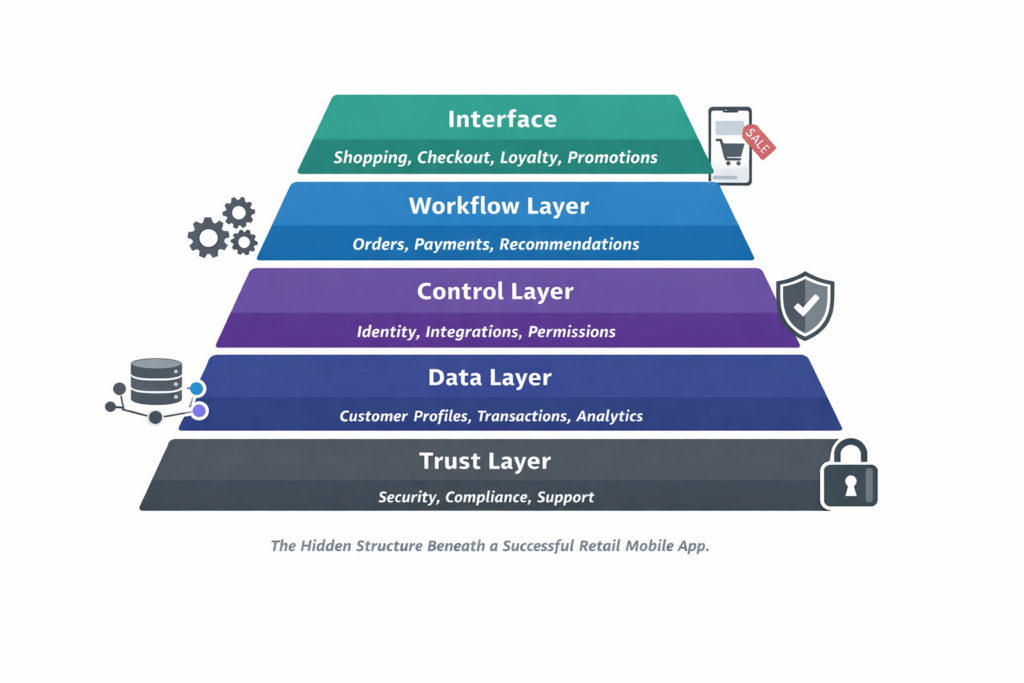
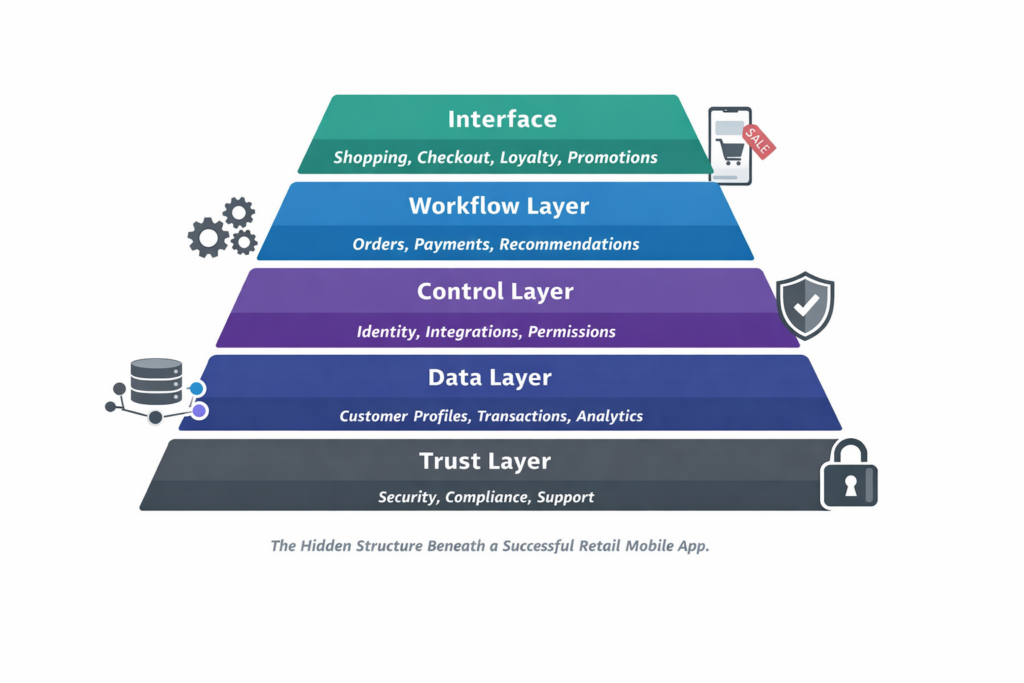
Beneath every successful application sits a far more complex structure that most people never see. At the surface is the interface where users interact with the product. Beneath that sit the workflows that execute business logic and enforce decisions. Supporting those workflows are systems that manage identity, permissions, integrations, and data. At the foundation is the trust layer that ensures security, reliability, compliance, and support.
When someone generates an application with AI, they are usually generating only the first of those layers. The rest still needs to be designed, operated, and maintained over time.
This distinction becomes clear the moment software moves from demonstration to production.
The Hard Part Is Scaling Usage
When we were building Outlook Mobile at Microsoft, the interface was never the hardest problem. Designing a clean inbox or a better calendar experience required care and craftsmanship, but those were not what determined whether the product would succeed.
The real challenge was building the system that allowed the product to scale adoption and usage.
We had to understand how often people opened the app, what they did during each session, and what experiences would turn occasional usage into daily habit. That required deep instrumentation to observe behavior clearly, combined with a product and growth system capable of responding quickly to what we learned.
We redesigned onboarding to remove friction without sacrificing security. We built notification systems that surfaced important messages without overwhelming users. And we did all of this while maintaining reliability and compatibility across millions of enterprise accounts.
The result was not just an application. It was an operational system that allowed the product to reliably scale and grow.
Those systems are invisible when you look at a prototype. They only become visible when the software begins carrying the weight of real-world usage.
This is exactly where most retail organizations underestimate what it takes to build a successful mobile channel.
Why This Is Hard for Retail
Retail brands are exceptional at merchandising, storytelling, marketing, and customer acquisition. Their organizations are designed to move quickly around product launches and campaigns. Operating a mobile software platform requires a completely different discipline.
Running a mobile channel means managing release cycles across two app stores, maintaining behavioral instrumentation, integrating identity with commerce systems, ensuring security and privacy compliance, and continuously iterating without disrupting the customer experience. Even large technology companies struggle with this work.
The real question for a retail brand, therefore, is not whether an app can be built.
The real question is whether the organization wants to operate a mobile software platform.
Most brands do not.
And they should not have to.
Retail leaders are measured against outcomes that require a strong direct relationship with their customers. Metrics like repeat purchase rate, customer lifetime value, loyalty participation, and blended acquisition costs increasingly determine whether a brand grows or stagnates. Achieving those outcomes requires a channel where customer identity is clear, behavior can be observed, and experiences can be refined over time.
Mobile is uniquely suited to play that role. Inside an app, identity is persistent. Behavior can be instrumented. Experiences can evolve continuously. The relationship between brand and customer becomes visible and deliberate.
But the infrastructure required to support that relationship is not trivial. It is the same operational system problem every successful software product eventually confronts.
Retail Brands Shouldn’t Have to Become Software Companies
This is precisely why Bryj exists.
Retail brands should not have to become mobile software companies in order to operate a mobile channel. Bryj Beam allows brands to launch a production-grade mobile presence quickly by transforming their existing website and commerce infrastructure into a fully operational app environment. Instead of building the underlying systems from scratch, brands begin with identity, instrumentation, and operational reliability already in place.
For organizations that require deeper customization, Bryj Managed delivers fully tailored mobile experiences while maintaining the infrastructure required to operate them at scale. Custom interfaces, complex integrations, and enterprise-grade security can all be delivered without forcing the retail organization itself to become responsible for maintaining the platform behind the app.
AI Changes How Software Is Built, Not What Businesses Need
Artificial intelligence will unquestionably change how software is built. Interfaces will be generated faster. Prototypes will become easier to produce.
But the operational systems that businesses depend on will not disappear.
AI may collapse the time required to generate an app. It does not collapse the time required to run one.
Retail brands do not need to become software companies. They simply need to decide whether they want to operate the systems that allow them to own the relationship with their customers.