Your Website Used to Own the Customer Relationship. It Doesn’t Anymore.
For the past decade, the playbook was simple. Drive traffic to your website. Convert visitors into customers. Retarget the ones who didn’t convert. Email the ones who did.
It worked because the website was the center of gravity. Google sent people there. Facebook sent people there. Your email list pulled people back. Every channel pointed at the same place, and the website held the relationship.
That model is breaking, and most brands are watching their organic traffic numbers and waiting for something that isn’t coming back.
What AI search changed
When ChatGPT, Google’s AI Overviews, and Perplexity give users a direct answer, those users don’t click. The question gets answered before the website ever gets visited.
Google’s AI Overviews have driven measurable click-through rate declines across informational and commercial queries. Search Engine Roundtable reported double-digit drops in organic CTR for categories where AI Overviews appear. Gartner projected in 2024 that organic search volume will drop 25% by 2026 as AI search behaviors compound. This is now happening.
These aren’t outlier cases. Brands across retail, financial services, and consumer categories are seeing organic traffic plateau or decline while their page rankings stay the same. The rankings didn’t change. The behavior of the person doing the search did.
The SEO investment that used to generate a predictable return on discovery now generates less of it with every quarter that passes. And there’s no optimization strategy that fixes a structural shift in how people find information.
A website is a destination. For it to work, someone has to decide to go there. That decision used to happen naturally, as a byproduct of search. It’s happening less.
The problem with every channel you’re already using
Step back and look at your current re-engagement toolkit.
Email open rates have been declining for years. The average B2C open rate across industries sits around 20-25%, and that number is inflated by Apple’s Mail Privacy Protection, which counts emails as “opened” when they’re pre-fetched, not when they’re actually read. True engagement is lower. The inbox is crowded, spam filters are better, and attention spans are shorter.
SMS converts well for brands that have earned the right to be there, but acquisition costs are high, opt-in rates are low, and the channel punishes over-senders immediately. You don’t get many chances to get the cadence wrong.
Paid social delivers reach, but you pay for every impression, every click, every return visit. When a customer who bought from you last month sees your retargeting ad on Instagram, you paid to reach your own customer.
Organic social has become a content production arms race with declining organic reach and a platform you don’t control. Meta changes the algorithm. TikTok gets scrutinized by regulators. LinkedIn shifts what it rewards. The channel is rented.
None of these are owned relationships. You’re renting access to your own customers, through someone else’s platform, on their terms.
What a mobile app offers
A mobile app icon on someone’s phone is different from every other channel in your mix. It doesn’t go through Google. It doesn’t go through Meta. It doesn’t sit in an inbox competing with 47 other messages.
It’s on the home screen. And once it’s there, you can reach that person for free, for as long as they keep the app installed.
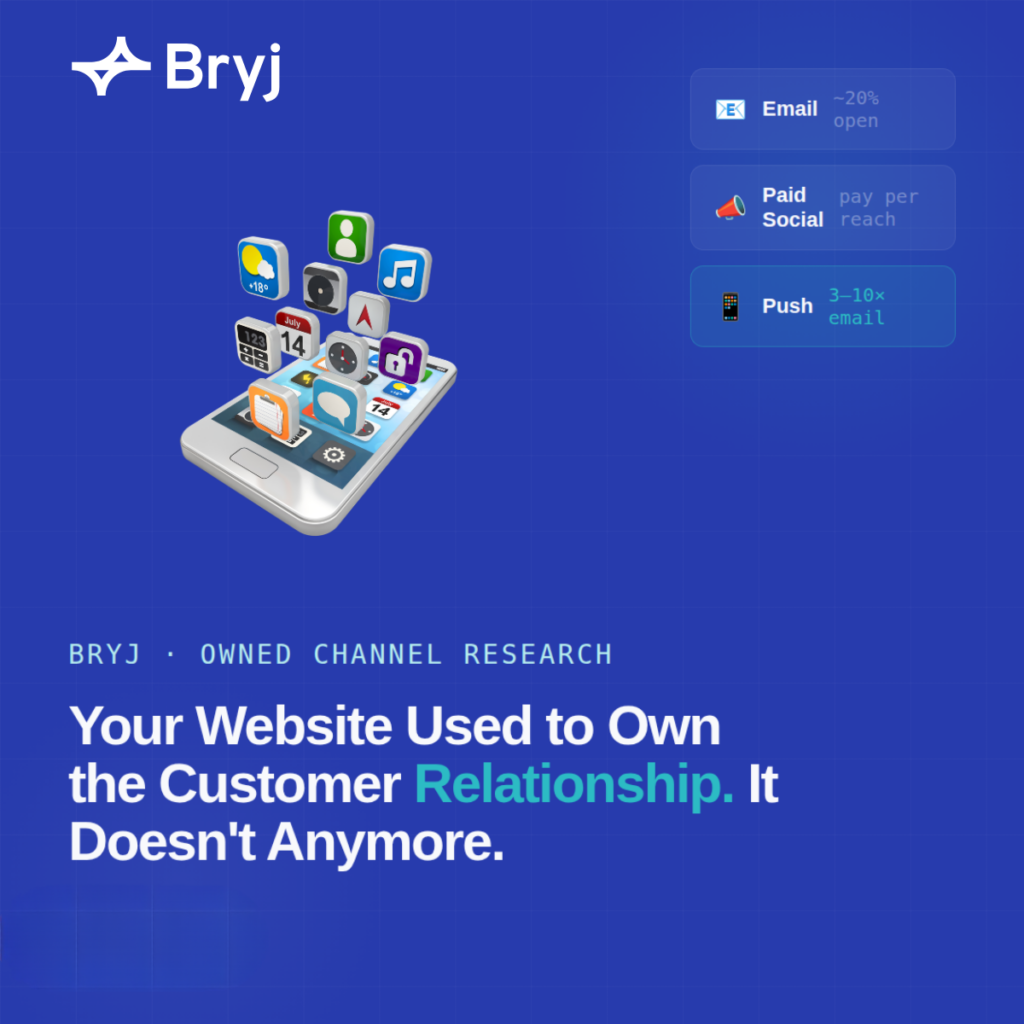
Push notifications drive 3 to 10 times higher re-engagement rates than email, according to data from Bryj’s customer base. App users average 3.2 times more sessions than mobile web visitors, a 50% higher conversion rate, and a 10% higher average order value. That’s not because apps are inherently more persuasive. It’s because the users who have your app installed are your most engaged customers, and the push notification reaches them in a moment of genuine attention, not inbox triage.
46% of retail purchases now happen through mobile apps — not mobile browsers, apps specifically. That number has been climbing for five consecutive years.
A push notification you send today doesn’t touch Google’s algorithm, Meta’s feed ranking, or your email deliverability score. It goes directly to the person who chose to install your app, at the moment you decide to send it.
The re-engagement math that most brands miss
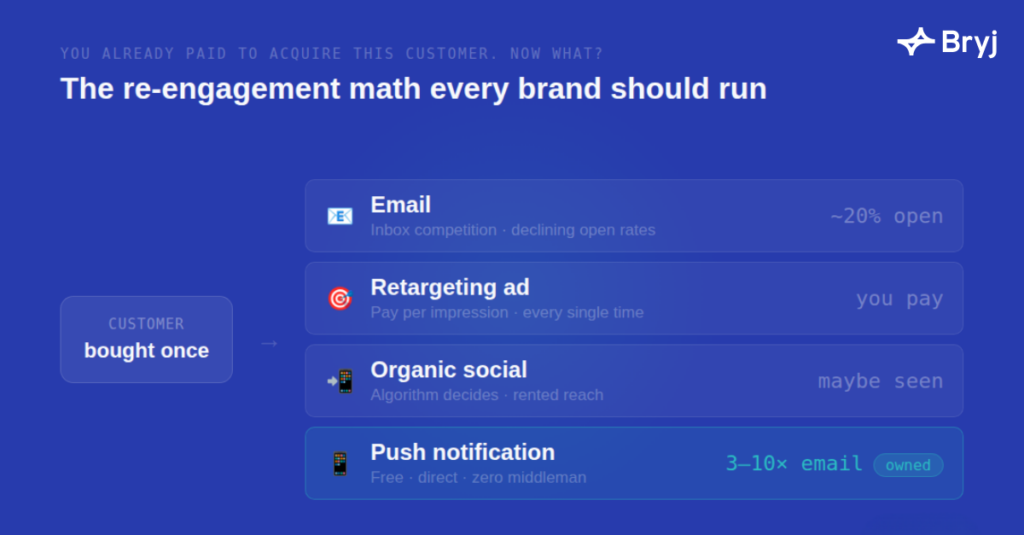
You acquire a customer. They buy once. To get them to buy again, you can email them at roughly 20% open rates, run a retargeting ad you’ll pay for per impression, post organic social, and hope the algorithm surfaces it to someone who already knows you, or send a push notification to the app they installed – free, direct, and at 3-10x the engagement rate of email.
The acquisition cost for that customer is already sunk. Every subsequent touch is about lifetime value, and every channel except mobile has a cost attached to every re-engagement.
The brands that understand this stop thinking about apps as features and start treating them as infrastructure. The app is the owned channel that makes every other channel more efficient, because the customers most likely to buy again are the ones already in it.
A jewelry brand thinking about app adoption correctly doesn’t measure success by download count. They measure it by wedding band conversion rate among engagement ring buyers who have the app installed. If that number moves 10%, the app has paid for itself several times over, and the next push notification costs nothing to send.
Why most brands haven’t done this yet
Until recently, building and maintaining a mobile app was genuinely hard.
The traditional path: hire an agency or assemble an internal dev team, spend 8 to 14 months and $150,000 to $400,000 on a native build, then maintain a separate engineering roadmap alongside everything else. Most marketing teams couldn’t justify that investment, and most dev teams had higher-priority projects.
The cost and complexity of building mobile apps has since dropped significantly. Platforms that let marketing teams build, launch, and iterate without engineering involvement have compressed the timeline from months to days.
The window for treating mobile as optional is shorter than most brands think. Every month a competitor’s app earns reviews, builds retention habits, and captures push notification opt-ins is a month of compounding advantage. The brands at the top of App Store category searches in 2027 are building that position right now.
The question worth asking your team today
If you wanted to change something in your mobile customer experience today (update a promotion, add a new product feature, send a targeted message to your top 500 buyers) who would do it?
Most teams answer honestly: nobody. Or: we’d submit a ticket. Or: we’d need to call the agency.
The teams that answer “our marketing team, in the platform, today” have a structural advantage that compounds with every campaign cycle. That’s what owning the mobile channel looks like.
We analyzed 1,000+ consumer brands to understand how wide the gap has become. The average app in that dataset hadn’t been updated in 259 days. 71% of web traffic across those brands was arriving on mobile. The average mobile health score: 66 out of 100. Most brands are sending the majority of their customers through a channel they’ve largely stopped investing in.
If you want to see where your brand sits, use our Mobile Readiness Scorecard to benchmark your mobile program in five minutes. And if the owned channel argument resonates but the execution feels out of reach, talk to our team about what a managed mobile program looks like.