The App Store Algorithm Punishes Brands That Stand Still
Your app launched well. Strong early reviews, a rating above 4.0, real downloads in the first quarter. You moved on to the next priority. And now, eighteen months later, someone is asking why organic installs have slowed.
Meanwhile, PacSun and Shoe Carnival are sitting at 4.6 and 4.7 stars in a category full of larger brands with bigger engineering teams. Not because they launched better than you, but because someone there never stopped treating the App Store as a live channel.
There wasn’t a single event that caused the gap. That’s the disorienting part. The product didn’t break. The reviews didn’t turn. There was no incident. There was just a long, unbroken absence of the decisions that would have kept the algorithm scoring your app as something worth surfacing.
That’s the mistake most brands make. They treat the App Store as a destination you arrive at. It’s actually a system you have to operate, and it scores you every day, whether you’re paying attention or not.

What the algorithm is actually measuring
Neither Apple nor Google publishes a complete ranking formula, but the signals that drive discovery are consistent enough across developer data to name with confidence.
The stores score recency. Apps that haven’t shipped an update in over 365 days are actively deprioritized in search results on both platforms. Apple’s guidelines note that apps untouched for a significant period may be removed from search entirely. An app that hasn’t shipped in a year isn’t neutral. It’s signaling abandonment.
The stores score rating velocity, not just rating score. A 4.6 rating earned mostly two years ago is worth less to the algorithm than a 4.2 with 200 fresh reviews from the past 90 days. The platforms are measuring evidence of an active user base. Stale ratings, even strong ones, are the absence of that evidence.
The stores score review response rate. On Google Play, the algorithm factors in whether developers respond to reviews. Negative reviews left unanswered compound the damage. A 3.8 with unanswered crash complaints is a different signal than a 3.8 where the team is visibly working on the problem, because your response is visible to every person who reads that review before deciding whether to download.
The stores score crash rates and performance telemetry. High crash rates and slow startup times are algorithm inputs, not just UX problems.
The stores score store page conversion. When a user lands on your listing and doesn’t download, that’s a negative signal. Screenshots from two redesigns ago, a description that mentions a promotional event from last year, a preview video showing UI that no longer exists, all of it kills conversion on every impression the app earns.
The algorithm does not measure what your app shipped at launch. It measures whether you are still shipping.
The floor brands mistake for fine
A 4.0 rating is often treated as acceptable. It isn’t.
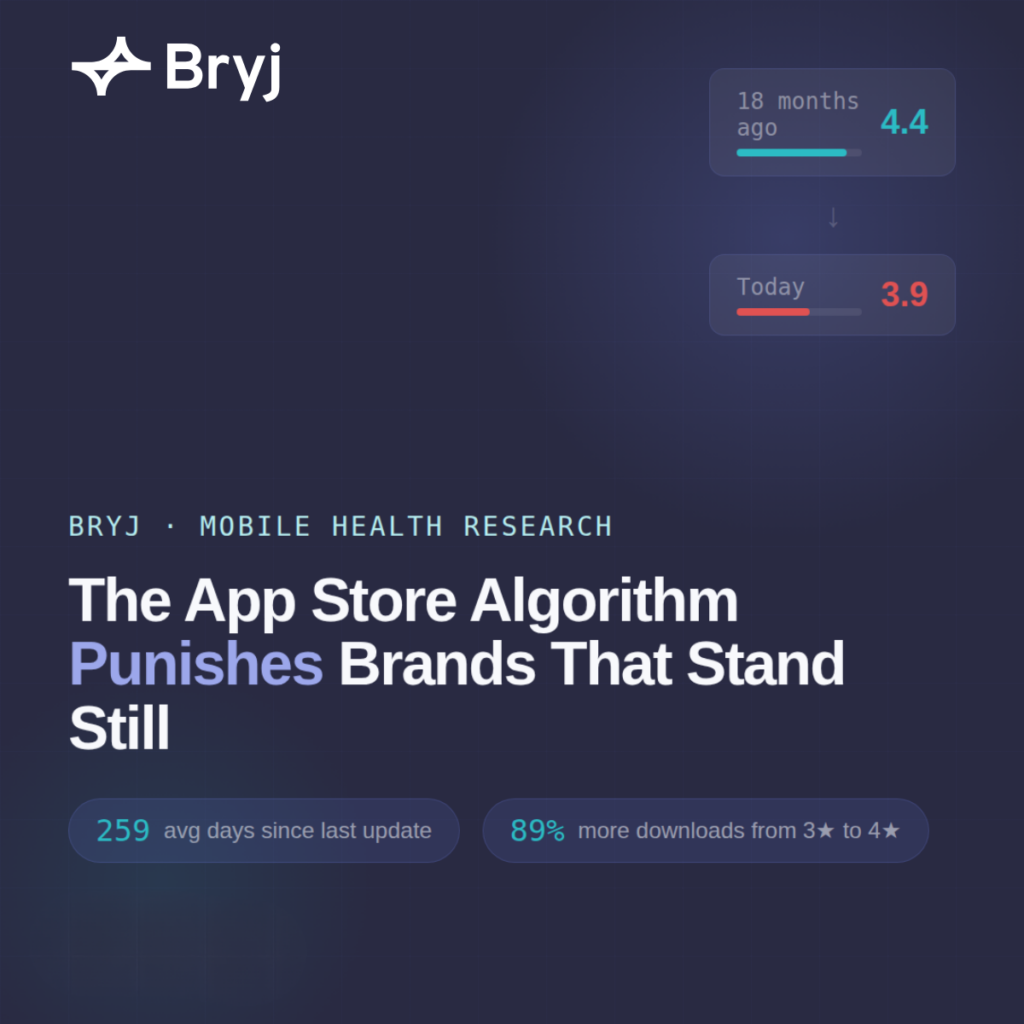
Search visibility drops measurably below 4.0. Research from Apptentive found that moving from a 3-star to a 4-star rating can increase downloads by 89%. That is not a marginal difference.
The more consequential threshold is 4.2. At 4.2 and above, an app is competitive. Below it, every search impression you earn comes with a structural headwind. Below 3.5, discoverability effectively collapses.
If your app isn’t requesting reviews after positive in-app interactions, a purchase completed, a reward redeemed, a booking confirmed, you are collecting reviews passively and losing the rating game to brands that aren’t. The correct moment to ask is immediately after the customer does something that felt good, not on a 14-day timer. Apple’s SKStoreReviewRequest API handles this natively. The brands using it aren’t more sophisticated. They made the decision to wire it in.
What standing still actually looks like
There’s a pattern that shows up consistently across retail.
A brand launches with strong intent. Downloads spike. Early ratings come from customers who were already fans. Then the mobile roadmap competes with everything else: a website migration, a CRM rollout, a brand refresh. Updates slow from monthly to quarterly, then to once a year. The screenshots still show the old UI. The description references a sale from 18 months ago.
Meanwhile, competitors are shipping updates monthly. Their ratings are climbing because they’re prompting for reviews after purchase. Their store listings reflect current features.
By the time someone looks at the rating trend, the app has slid from 4.4 to 3.9 over 18 months. Not because customers dislike the product. Because the brand stopped hearing from the satisfied ones, and the algorithm registered the silence.
The rating didn’t collapse. The operating model went dark.
The discipline that compounds
The brands at the top of their category App Store ratings, brands like PacSun at 4.6 and Shoe Carnival at 4.7, aren’t there because they launched well. They’re there because mobile performance is tracked alongside every other marketing metric, and it never stops being tracked.
They ship updates on a visible cadence. Not always major feature releases. Bug fixes, performance improvements, minor UI polish, all of it signals to the algorithm, and to users checking the version history tab, that this product is maintained.
They refresh store listings quarterly so screenshots reflect current UI and the description names current features.
They respond to negative reviews within 48 hours. Not to win back the reviewer, but because the response is visible to every person evaluating the download.
They track rating velocity weekly, because the trend matters more than the snapshot. A 4.3 that’s been rising for 60 days is a different asset than a 4.3 that’s been declining for 60 days.
None of this is a list of tactics. It is an operating model. Tactics are discrete events. An operating model runs continuously and compounds. Or it doesn’t run, and the slide is continuous instead.
What the data shows
We recently analyzed over 1,000 consumer brand apps and measured this compounding effect directly. The mean days since last app update across the dataset: 259. Apps updated within 14 days consistently scored 97 to 100 on our Mobile Health Score. Apps untouched for 200 days or more scored 51 to 66.
The gap isn’t theoretical. It’s in the data, and it widens every quarter a brand treats its app as a shipped artifact rather than a live channel.
The decision
The brands losing ground in App Store search aren’t losing it because their products are bad. They’re losing it because they’re operating a live channel with a launch mindset.
Your app doesn’t need a rebuild. It needs a program.
The brands that close the gap do it the same way: by treating app health the way they treat any compounding asset, as something that requires continuous decisions, not just an initial one. The brands that don’t will keep watching the rating decline and looking for the specific event that caused it.
There isn’t one. There’s just the absence of the operating model that would have prevented it.
If you want to see where your app stands, use our Mobile Readiness Scorecard to benchmark yourself against 1,000+ brands in five minutes. Or if mobile is a strategic priority and you need a partner to run it, talk to our team about what a managed mobile program looks like for your category.