Why Most Retail Mobile Apps Never Become Revenue Channels
Launch Is Only the First Hurdle
In a previous article, we argued that most retail mobile apps fail before they launch. Brands often underestimate the design, engineering, and operational effort required to build a mobile experience customers will actually want to use. As a result, many apps never reach the level of quality required to compete for attention on a customer’s phone.
But building and launching is only the first hurdle.
Even when a brand successfully releases a well-designed mobile app, another problem quickly appears. The app exists and customers download it, but the app never becomes a meaningful revenue channel for the business.
There’s an app, but there’s no engagement. No customer relationship.
Downloads plateau. Engagement gradually fades. Push notifications lose their effectiveness. The app continues to operate, but it never develops into the growth engine the company hoped it would become.
Inside the organization, the conversation often turns to features. Should the loyalty program change? Should personalization improve? Should more notifications be sent?
Those questions miss the underlying issue.
An app by itself is not a growth channel. A growth channel is an economic system. And most retail apps are never designed as systems.
The Mobile Experience Is the Product
Part of the confusion comes from how the word product is interpreted inside retail organizations.
When marketers hear that word, they naturally think about the merchandise their company sells: clothing, cosmetics, cars, or electronics. But in the context of mobile growth, the product is the digital experience customers interact with. The mobile app itself is the product.
Products create value. What determines whether that value becomes a durable business advantage is the key.
When a retail app succeeds, it is not simply because the interface is well designed. It is because the value the experience creates begins to shape customer behavior in ways that strengthen the business over time. Customers return more frequently. Purchases shift toward the channel. Retention improves. Customer lifetime value increases.
Over time, the channel becomes economically powerful because the behaviors it produces reinforce the company’s position.
When an app fails to reach that point, the issue is rarely the design of the app itself. The issue is that the system required to produce those behaviors was never fully designed.
A Lesson from Outlook Mobile
I first saw this dynamic while working on Outlook Mobile at Microsoft.
Outlook Mobile succeeded because it solved a real problem elegantly. It was faster, simpler, and more respectful of the user than the alternatives people were used to. Adoption came quickly because the product experience was genuinely better.
But the deeper lesson was not simply that a good product can attract users. The deeper lesson was what happened after those users arrived.
Outlook Mobile became an entry point into the broader Microsoft 365 ecosystem. The product created pull at the edge of the system, and the company was designed to convert that pull into a much larger commercial outcome. Product adoption led naturally into deeper engagement with the broader platform.
That experience shaped how I think about the relationship between products and companies. Products create value, but the companies that win are the ones that design the system that turns that value into durable economic advantage.
The System Behind Durable Growth
This system is what I call Product-Led Economics.
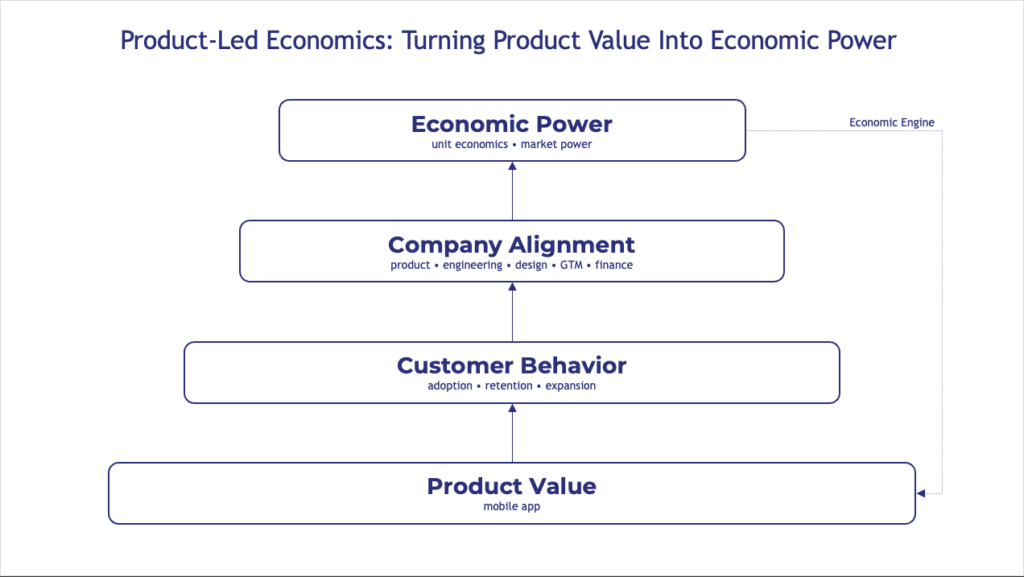
Product-Led Economics describes the mechanism through which product value drives customer behavior, customer behavior creates economic outcomes, and those outcomes ultimately produce durable market power.
(I recently explored this idea in more depth in an essay titled “Great Products Don’t Build Great Companies.”)
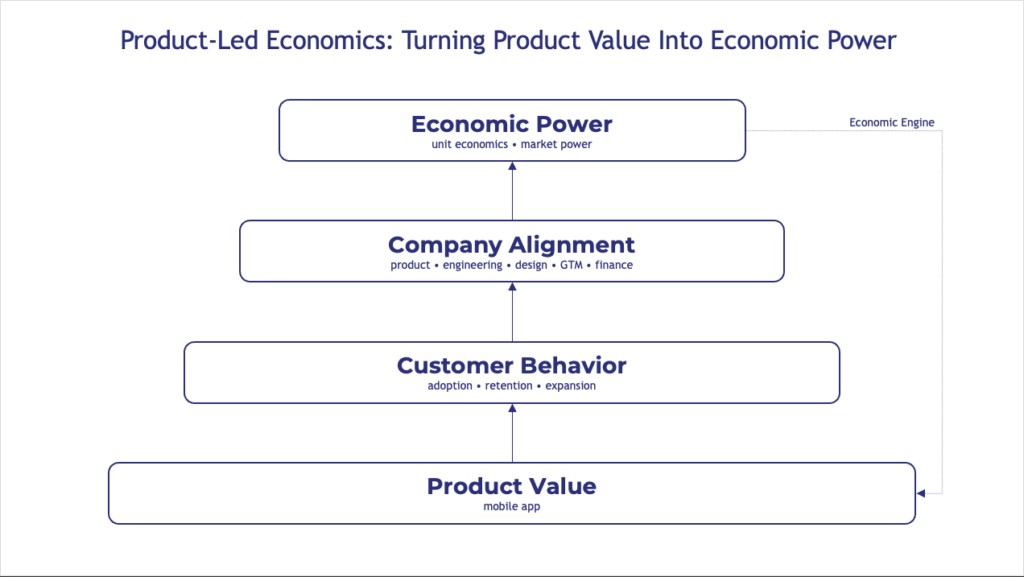
Products do not create businesses directly. They create value. The real question is whether that value produces the customer behaviors the business needs and whether the organization aligns around reinforcing those behaviors.
In retail mobile, that progression becomes visible once you begin looking for it.
An app creates value when it gives customers a reason to open it. That value may come from convenience, loyalty rewards, personalization, or simply a faster shopping experience. But value alone is not enough. What matters is whether that value begins to shape customer behavior in durable ways.
Where Most Retail Apps Break Down
When customers open an app repeatedly and gradually shift more of their purchasing activity into the channel, the behavioral layer of the system begins to take hold.
At that point the role of the company becomes critical. Marketing, merchandising, product, and growth teams must begin reinforcing those behaviors through the programs they design. Loyalty programs encourage repeat interaction. Lifecycle messaging brings customers back. Targeted promotions reward engagement. App-exclusive experiences give customers a reason to return.
When these layers begin to align, the economics of the channel change. Retention improves. Customer lifetime value increases. Acquisition becomes more efficient because existing customers return more often.
Many retail apps never reach this stage. The product may be well designed, but it is not embedded in a system that encourages repeated interaction. Without that repetition, the app remains a useful utility rather than becoming a durable growth channel.
From Mobile App to Growth Engine
The brands that succeed with mobile approach the problem differently.
They do not treat their apps as digital storefronts that simply replicate the website. They treat them as behavioral systems designed to encourage repeated interaction with the brand.
Over time those patterns compound. Customers open the app more frequently. A larger share of purchases happens inside the channel. The economics of the relationship begin to reinforce themselves.
At that point the mobile app stops being an experiment and becomes part of the company’s economic infrastructure.
At Bryj, we see this challenge repeatedly across the retail landscape. Many brands already have capable mobile apps. What they often lack is the system required to turn those apps into engines of growth.
That is why our focus is not simply on helping brands launch mobile apps. The real goal is helping them design the system around the app: the behaviors it encourages, the programs that reinforce those behaviors, and the economic outcomes that follow.
Because the goal of a retail mobile app is not simply to function well. The goal is for the value it creates to compound into something much more powerful: a channel that continuously converts customer engagement into a relationship that drives stronger unit economics and long-term growth.